-->
Showing posts with label aladdin cartoon. Show all posts

Sunday, November 7, 2010

Thanksgiving Day

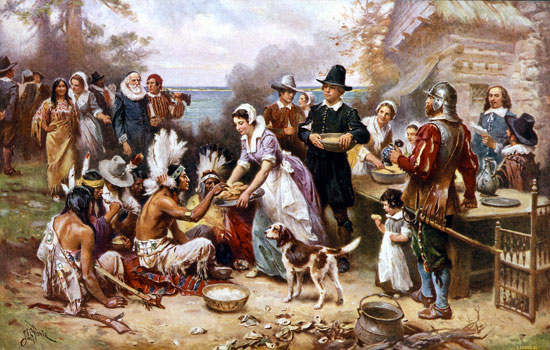
Thanksgiving Day is a harvest festival celebrated primarily in the United States and Canada. Thanksgiving is a holiday to express thankfulness, gratitude, and appreciation to God, family and friends for which all have been blessed of material possessions and relationships. Traditionally, it has been a time to give thanks for a bountiful harvest. This holiday has since moved away from its religious roots.

Thanksgiving DayThanksgiving Day
In the United States, Thanksgiving Day falls on the fourth Thursday of November. In Canada it is celebrated on the second Monday in October.

Thanksgiving DayThanksgiving Day
The precise historical origin of the holiday is disputed. Although Americans commonly believe that the first Thanksgiving happened in 1621, at Plymouth Plantation, in Massachusetts, there is strong evidence for earlier celebrations in Canada (1578) and by Spanish explorers in Florida (1565).

Thanksgiving Day is also celebrated in the Netherlands. A different holiday which uses the same name is celebrated at a similar time of year in the island of Grenada.
Thanksgiving Day
Thanksgiving Day
Thanksgiving Day
Thanksgiving Day
Thanksgiving Day
Thanksgiving Day
Thanksgiving Day
Thanksgiving Day
Thanksgiving DayThanksgiving Day

Sunday, March 1, 2009

Snow White Cartoon

Snow White is a 1933 animated short film in the Betty Boop series from Max Fleischer's Fleischer Studios. Dave Fleischer was credited as director, although virtually all the animation was done by Roland Crandall. Crandall received the opportunity to make Snow White on his own as a reward for his several years of devotion to the Fleischer studio, and the resulting film is considered both his masterwork and an important milestone of The Golden Age of American animation.

Snow White Cartoon
Snow White Cartoon
A magic mirror, with a face resembling Cab Calloway, proclaims Betty Boop to be "the fairest in the land", much to the anger of the Queen. The Queen orders her guards Bimbo and Koko to behead Betty. With tears in their eyes, they take Betty into the forest and prepare to execute her. Betty escapes into a frozen river, which encloses her in a coffin of ice. This block slips downhill to the home of the seven dwarfs, who carry the frozen Betty into an enchanted cave. Meanwhile, Koko falls down a hole and arrives at the same cave, where the evil Queen turns him into a grotesque creature, all while singing the St James Infirmary Blues. With her rivals disposed of, the Queen again asks the magic mirror who the fairest in the land is, but the mirror explodes in a puff of magic smoke that returns Betty and Koko to their normal states and changes the Queen into a hideous monster. The queen monster chases the protagonists until Koko grabs its tongue and, with one mighty yank turns it inside out. Betty, Koko, and Bimbo dance around in a circle of victory as the film ends.

Snow White Cartoon
Snow White Cartoon
This plot, such as it is, is really more a framework to display a series of gags, musical selections, and animation. Critics have cited the film as having some of the most imaginative animation and background drawings from the Fleischer Studios artists. Mae Questel does the voices of Betty Boop and the Olive Oyl-ish Queen, and Cab Calloway does the voice of Koko the Clown, singing "St. James Infirmary Blues". Koko's dancing during the "St. James" number is rotoscoped from footage of Calloway.

Snow White Cartoon
Snow White Cartoon
The film has been deemed "culturally significant" by the United States Library of Congress and selected for preservation in the National Film Registry. In 1994 it was voted #19 of the 50 Greatest Cartoons of all time by members of the animation field. The film is now public domain.
Snow White Cartoon
Snow White CartoonSnow White CartoonSnow White CartoonSnow White CartoonSnow White Cartoon
Snow White Cartoon

Sunday, December 14, 2008

Hello Kitty Cartoon

Hello Kitty, full name Kitty White (Kiti Howaito), is the best-known of many simply drawn fictional characters produced by the Japanese company Sanrio. Hello Kitty is a friendly white kitty with the head larger than her body, small button eyes and nose, but no mouth. She is said to be five apples tall and the weight of three apples.

Hello Kitty Cartoon
Hello Kitty Cartoon
In 1974, Sanrio Co. Ltd. of Tokyo, introduced the Hello Kitty franchise. The first Hello Kitty item was a vinyl coin purse sold in Tokyo, according to Sanrio Inc.'s U.S. marketing director Bill Hensley. In 1976, the franchise was introduced into the U.S. The Hello Kitty line has developed under licensing arrangements worth more than $1 billion a year in sales. Examples of products depicting the character include dolls, stickers and greeting cards to clothes, accessories, school supplies, dishes and home appliances. Sanrio Puroland is the official theme park of Sanrio featuring Hello Kitty and her friends.

Hello Kitty Cartoon 2Hello Kitty Cartoon
According to Sanrio's website, Hello Kitty was born on November 1st and lives in London with her parents and twin sister Mimmy. Since 2004 she has had a pet cat called Charmmy Kitty and a pet hamster called Sugar. Charmmy Kitty resembles Hello Kitty but has more cat-like features. Charmmy Kitty was given to Hello Kitty by her papa, George White; her mama, Mary White; her twin sister Mimmy; and her grandparents, Anthony and Margret White.

Hello Kitty CartoonHello Kitty Cartoon
Hello Kitty's fictional world includes many friends and family members. She is friends with other famous Sanrio characters, such as Cinnamoroll, Chococat, and Badtz Maru.

Hello Kitty is a cute and inisent little chartoon charter. That is kind and teachs children some maners and stuff they should know. Children would also look up to her as a role model because she does every little thing that a person or a child would want to be when they grow up. So Hello Kitty is not only a cute kitty. She is a role model, that children look up to when they grow up into teen age years and maybe adult years. Who knows!!!
Hello Kitty Cartoon
Hello Kitty Cartoon
Hello Kitty CartoonHello Kitty Cartoon

Slipper Cartoon

Early on in a child's life, it seems, they find one particular cartoon character that they seem to fixate upon. Each child has his or her favorite. You know the one, the show that you have on videotape that they insist upon watching over and over again, every single day. Of course, they know it so well that they can almost repeat every word, but still, they love the starring character.

Slipper Cartoon 1
Slipper Cartoon
This can be almost aggravating, but do not discourage this aspect of your child. Cartoon characters are tools that can be used for teaching a child. The key is to find the perfect character that has the most to offer in educational and moral instruction, and to introduce that character to the child early in life. If you find the right character, there are even manners in which you can "promote" the character to the child, making him more fond of it.

This is achieved by simply buying themed items. If you want to buy a stuffed animal for your child, get one of this particular character. If you are clothes shopping, see if you can find a shirt or a hat with this character on it. The most popular way to get connect the child with the character, however, is that of the novelty cartoon character slippers or house shoes.

Small children seem to have a deep interest in shoes. They love a new pair of house shoes or slippers with a cartoon character on it. When you buy the slippers, the child will excitedly put them on and run around the house.

When raising your child, remember, any tool that teaches them good moral fiber is a tool well worth investing in.
Slipper Cartoon
Slipper Cartoon 4Slipper Cartoon 5
Slipper Cartoon

Saturday, December 13, 2008

Tarzan Cartoon

Tarzan is the son of a British Lord and Lady who were marooned on the West coast of Africa by mutineers. When Tarzan was a year old, his mother died of natural causes, and his father was killed by Kerchak, leader of the ape tribe into which Tarzan was adopted. Kerchak's tribe of apes is known as the Mangani, Great Apes of a species unknown to science. Kala is his ape mother. Tarzan (White-skin) is his ape name; his English name is John Clayton, Lord Greystoke (the formal title is Viscount Greystoke according to Burroughs in Tarzan, Lord of the Jungle; Earl of Greystoke in later, non-canonical sources, notably the 1984 movie Greystoke).

Tarzan Cartoon 1
Tarzan Cartoon
As a young adult, he meets a young American woman, Jane Porter, who along with her father and others of their party is marooned at exactly the same spot on the African coast where Tarzan's parents were twenty years earlier. When she returns to America, he leaves the jungle in search of her, his one true love. In later books, Tarzan and Jane marry and he lives with her for a time in England. They have one son, Jack, who takes the ape name Korak the Killer. Tarzan is contemptuous of the hypocrisy of civilization, and he and Jane return to Africa, making their home on an extensive estate that becomes a base for Tarzan's later adventures.

Tarzan Cartoon 2Tarzan Cartoon
In Tarzan, Burroughs created an extreme example of a hero figure largely unalloyed with character flaws or faults. He is described as being Caucasian, extremely athletic, tall, handsome, and tanned, with grey eyes and black hair. Emotionally, he is courageous, loyal and steady. He is intelligent and learns new languages easily. He is presented as behaving ethically, at least by Burroughs' definitions, in most situations, except when seeking vengeance under the motivation of grief, as when his ape mother Kala is killed in Tarzan of the Apes, or when he believes Jane has been murdered in Tarzan the Untamed. He is deeply in love with his wife and totally devoted to her, and in numerous situations where other women express their attraction to Tarzan, politely but firmly declines their attentions. When presented with a situation where a weaker individual or party is being preyed upon by a stronger foe, Tarzan invariably takes the part of the weaker party. In dealing with other men Tarzan is firm and forceful. With male friends he is reserved but deeply loyal and generous. As a host he is likewise generous and gracious. As a leader he commands devoted loyalty.

Tarzan Cartoon 4Tarzan Cartoon 5Tarzan Cartoon
In contrast to these noble characteristics, Tarzan's philosophy embraces an extreme form of "return to nature." Although he is able to pass within society as a civilized individual, he prefers to "strip off the thin veneer of civilization," as Burroughs often puts it. His preferred dress is a knife and a loincloth of animal hide, his preferred abode is a convenient tree branch which happens to be nearby when he desires to sleep, and his favored food is raw meat, killed by himself; even better if he is able to bury it a week so that putrefaction has had a chance to tenderize it a bit.
Tarzan Cartoon
Tarzan Cartoon 5Tarzan Cartoon 6Tarzan Cartoon 7Tarzan Cartoon 8Tarzan Cartoon 9Tarzan Cartoon 10
Tarzan CartoonTarzan Cartoon

Aladdin Cartoon

Aladdin is a 1992 animated feature produced by Walt Disney Feature Animation, and released by Walt Disney Pictures on November 25, 1992. The thirty-first animated feature in the Disney animated features canon, the film is based on the Arab folktale of Aladdin and the magic lamp from One Thousand and One Nights. Several characters and plot elements are also based on the 1940 version of The Thief of Bagdad. Many aspects of the traditional story were changed for the film—for instance, the setting is changed from "China" to a fictional Arabian city, Agrabah. It was released at the peak stretch of the era known as the Disney Renaissance beginning with The Little Mermaid. Aladdin was the most successful film of 1992, earning over $217 million in revenue in the United States, and over $504 million worldwide.

Aladdin Cartoon 1Aladdin Cartoon2
Aladdin Cartoon
The film was directed by John Musker and Ron Clements, both of whom had just finished writing and directing The Little Mermaid (1989). The musical score was written by Alan Menken, with lyrics written by Howard Ashman and Tim Rice. Aladdin features the voices of Scott Weinger, Jonathan Freeman, Linda Larkin, Frank Welker, Gilbert Gottfried, Douglas Seale, and, as the Genie of the lamp, Robin Williams. Although this was not the first time in which a major actor such as Williams provided voice-over work for an animated film, it was the first major American animated feature film in which particular attention was paid to a celebrity voice cast member, such as a major movie star, in the film as part of its promotion. This has led to a subsequent increased attention to the casts of later productions, as a major element of animated film marketing.

Aladdin Cartoon 4Aladdin Cartoon
Aladdin was followed by two direct-to-video sequels: The Return of Jafar (1994) and Aladdin and the King of Thieves (1996), and an animated television series, Aladdin, set between the two sequels.
Aladdin Cartoon
Aladdin Cartoon 5Aladdin Cartoon 7Aladdin Cartoon 8Aladdin Cartoon 9Aladdin Cartoon 10
Aladdin Cartoon 12Aladdin Cartoon

Goofy Cartoon

Goofy is an animated cartoon character from the Walt Disney's Mickey Mouse universe. He is an anthropomorphic Dog, and not a cow, as many people belive... and is one of Mickey Mouse's best friends. His original concept name was "Dippy Dawg" in cartoon shorts created during the 1930s; then his name was given as "George Geef" or "G.G. Geef" in cartoon shorts during the 1950s (implying that "Goofy" was a nickname). Contemporary sources, including the Goof Troop television show and A Goofy Movie, now give the character's full name to be Goofy Goof. The Goof Troop pilot also refers to 'G. G. Goof' on a diploma, likely a reference to the original name. Along with being not extremely intelligent, Goofy's main flaw is, predictably, clumsiness. On the map in A Goofy Movie that shows the trip that Goofy senior and his father took, it says that the map belongs to Benjamin Goof, again changing the name of the famous character.

Goofy Cartoon 1Goofy Cartoon 2
Goofy Cartoon
The Goof Troop pilot refers to Goofy as "G. G. Goof" on a diploma, likely a reference to the original name. In the film A Goofy Movie, a map belonging to Benjamin Goof depicts a trip that Goofy took with his father, implying Benjamin as the name of Goofy's paternal parent. In the television series Goof Troop, Goofy claims he was born in California as the first-born Goof in America.

Goofy Cartoon 3Goofy Cartoon
Goofy's wife has been seen in some earlier short cartoons depicting the character as a "family man," but his modern appearances portray Goofy as a widower. As a single father raising his son, Max Goof, Goofy's family life contrasts with other major Disney characters such as Mickey Mouse and Donald Duck, who are often shown only as uncles rather than parental figures. Goofy does have a nephew, Gilbert, but that relative has hardly been seen since Goofy became known as a father. Goofy also has an adventurer relative Arizona Goof (a spoof of Indiana Jones).

Goofy's catch phrase is "gawrsh!" which is his usual exclamation of surprise, along with an ahyuck (a distinctive high-pitched chuckle). He commonly wears a green hat, an orange shirt, blue jeans, and brown shoes.
Goofy CartoonGoofy Cartoon 5Goofy Cartoon 6
Goofy Cartoon